
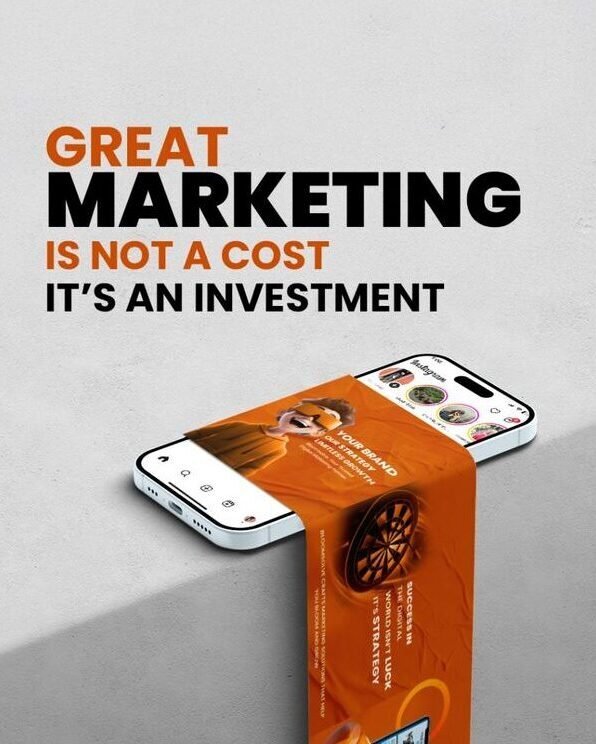
Marketing Is Not a Cost—It’s an Investment
For decades, businesses—especially small and mid-sized ones—have treated marketing as a discretionary expense. Something to be trimmed when budgets tighten, or worse, something to be avoided altogether until “the time is right.” But this mindset is fundamentally flawed. Marketing is not a cost to be minimized; it is an investment to be optimized.
Understanding this shift in perspective can mean the difference between a business that survives and one that thrives.
The Cost vs. Investment Mindset
At its core, the difference between a cost and an investment lies in the return. A cost is something you spend money on with no expectation of measurable gain. An investment, on the other hand, is money deployed with the expectation of generating future value.
When businesses label marketing as a cost, they subconsciously devalue it. They focus on how much they are spending rather than what they are gaining. This often leads to underfunded campaigns, inconsistent branding, and reactive decision-making.
But when marketing is viewed as an investment, the conversation changes. Leaders begin asking better questions:
What is our return on this campaign?
How does this improve brand equity?
Are we reaching the right audience effectively?
This shift transforms marketing from an afterthought into a strategic growth engine.
Marketing Drives Revenue—Directly and Indirectly
One of the biggest misconceptions is that marketing is disconnected from revenue. In reality, marketing is one of the primary drivers of it.
Directly, marketing generates leads, conversions, and sales. Whether it’s through digital ads, email campaigns, SEO, or social media, every marketing effort is designed to move potential customers closer to a purchase.
Indirectly, marketing builds brand awareness, trust, and loyalty. These intangible assets are incredibly valuable. A strong brand reduces customer acquisition costs, increases customer lifetime value, and creates a competitive moat that is difficult to replicate.
Think about it this way: when customers already know and trust your brand, they are far more likely to choose you over a competitor—even at a higher price.
The Compounding Effect of Consistent Marketing
Unlike many business expenses that deliver one-time value, marketing compounds over time.
A blog post written today can generate traffic for years. A well-optimized website continues to attract organic visitors without ongoing ad spend. A strong social media presence builds relationships that deepen with every interaction.
This compounding effect is what makes marketing such a powerful investment. The returns are not always immediate, but they grow exponentially when efforts are consistent and strategic.
However, this is also why many businesses get it wrong. They expect instant results, don’t see them, and then pull back. In doing so, they interrupt the compounding process and never realize the full potential of their investment.
Data Makes Marketing Measurable
Another reason marketing is often misclassified as a cost is the perceived lack of measurability. In the past, it was difficult to directly attribute sales to specific marketing efforts.
Today, that excuse no longer holds.
Modern tools and analytics platforms allow businesses to track nearly every aspect of their marketing performance:
Website traffic and user behavior
Conversion rates
Cost per acquisition (CPA)
Return on ad spend (ROAS)
Customer lifetime value (CLV)
With this level of insight, marketing becomes one of the most measurable and optimizable functions in a business. You can test, learn, iterate, and improve continuously.
When done correctly, marketing is not a gamble—it’s a calculated investment backed by data.
Cutting Marketing Is Often a Costly Mistake
During economic downturns or periods of uncertainty, marketing budgets are often the first to be cut. While this may provide short-term financial relief, it usually leads to long-term damage.
Reducing marketing efforts decreases visibility, weakens brand presence, and allows competitors to capture market share. Once lost, regaining that position is far more expensive than maintaining it.
History has shown that companies that continue investing in marketing during tough times often emerge stronger. They benefit from reduced competition, lower advertising costs, and increased brand recognition when the market recovers.
In contrast, those who cut back often struggle to catch up.
Marketing Builds Long-Term Assets
Unlike many operational expenses, marketing creates assets that continue to deliver value over time.
These assets include:
Brand recognition and reputation
Content libraries (blogs, videos, guides)
Customer relationships and email lists
Search engine rankings
Social media communities
These are not fleeting benefits. They are durable advantages that strengthen your business over the long term.
For example, a well-ranked website page can generate leads for years without additional investment. An engaged email list can drive repeat sales at minimal cost. These are the kinds of returns that make marketing one of the highest-ROI investments available.
The Risk of Underinvestment
Ironically, the biggest risk in marketing is not overspending—it’s underinvesting.
When businesses allocate too little budget, they often spread it too thin across multiple channels without achieving meaningful impact anywhere. This leads to poor results, which then reinforces the belief that “marketing doesn’t work.”
In reality, the issue is not marketing itself, but the lack of sufficient investment and strategy.
Effective marketing requires focus, consistency, and adequate resources. It’s better to do a few things well than many things poorly.
Thinking Like an Investor
To truly benefit from marketing, businesses must adopt an investor’s mindset.
Investors don’t expect guaranteed outcomes, but they do expect informed decisions, calculated risks, and long-term returns. They diversify, analyze performance, and adjust strategies based on results.
The same approach applies to marketing:
Set clear objectives and KPIs
Allocate budget strategically
Test different channels and messages
Analyze performance regularly
Double down on what works
When marketing is approached with this level of discipline, it becomes a predictable and scalable growth driver.
Conclusion
Marketing is not a line item to be minimized—it is a lever to be pulled.
Treating it as a cost limits your growth and blinds you to its true potential. Treating it as an investment, however, unlocks opportunities to build brand equity, generate revenue, and create long-term value.
The businesses that understand this distinction are the ones that don’t just compete—they lead.
In a world where attention is currency, marketing is how you earn it. And like any good investment, the returns are there for those willing to commit, stay consistent, and think long term.